
Applying for a PhD in USA with funding is possible, but it needs clear planning. With guidance from Crown Bridge International, students can better understand how to choose the right research area, check university requirements, find professors or departments that match their interests, prepare strong documents, apply before deadlines, and explore funding options like research assistantships, teaching assistantships, fellowships, scholarships, and tuition waivers.
For Nepali students, the USA remains one of the strongest destinations for advanced research. According to Open Doors 2025, U.S. colleges and universities hosted 1,177,766 international students in the 2024/25 academic year, showing how popular the USA still is for global education.
But a PhD is not like a normal bachelor’s or master’s application. It is research-focused. Universities want to know what you want to study, why it matters, whether your academic background fits, and whether their faculty can support your research. So, if you want funding, your application must show purpose, preparation, and a strong research fit.
Step-by-Step Process to Apply for a PhD in USA with Funding
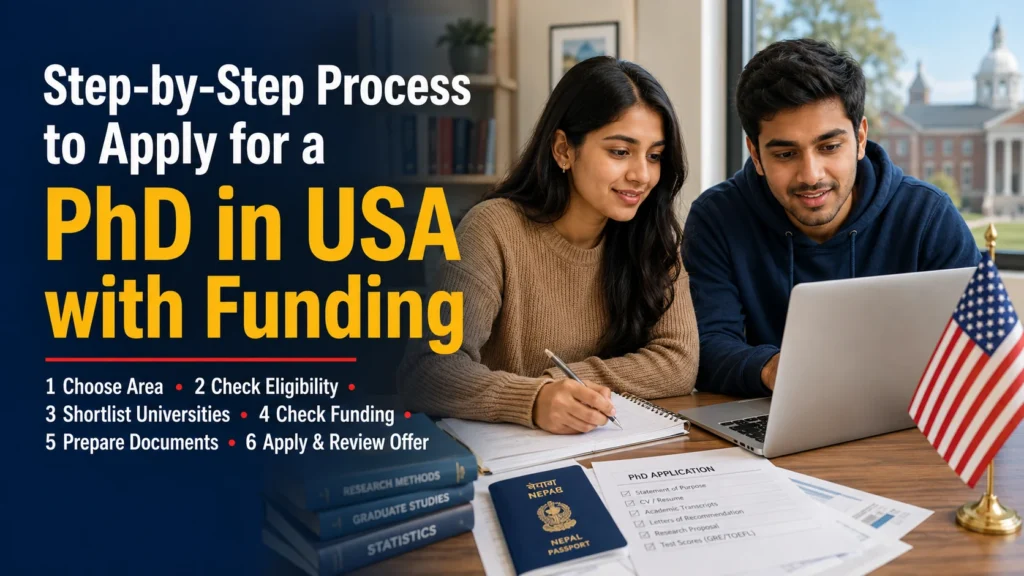
The best way to apply for a PhD in USA with funding is to follow a clear step-by-step process. Funding is competitive, so your goal should be to show academic ability, research interest, and a strong match with the university.
Step 1: Choose Your Research Area
Start by choosing a clear research area. Instead of saying “computer science,” make it more specific, like artificial intelligence, cybersecurity, data science, software engineering, or human-computer interaction.
A PhD is about solving a research problem. The clearer your interest is, the easier it becomes to find the right university, professor, and funding option.
Step 2: Check PhD Eligibility Requirements
After choosing your research area, check whether you meet the basic requirements. Most U.S. graduate programs expect strong academics, English language ability, and sometimes GRE or GMAT scores, depending on the program.
USEF Nepal explains that students planning for U.S. graduate study should usually have at least 16 years of education in the relevant field. This matters for Nepali students because some students have three-year bachelor’s degrees, while others have four-year degrees or a bachelor’s plus master’s.
Step 3: Shortlist Universities and Professors
Do not choose universities only by ranking. For PhD admission, research fit matters more. Look for universities where professors are working in your area of interest.
Check faculty profiles, lab pages, recent publications, department funding pages, assistantship options, and admission requirements. A famous university with no professor in your field may not be the right fit.
Step 4: Check Funding Before Applying
Before paying application fees, check whether the PhD program offers funding. Some programs clearly mention full funding, assistantships, fellowships, or tuition waivers. Others may ask students to apply separately.
This matters because studying in the USA without funding can be expensive. USEF Nepal notes that U.S. colleges and universities may cost around $15,000 to $65,000 per year, depending on the institution and study level.
Step 5: Prepare PhD-Focused Documents
Your documents should not look like a normal study abroad application. A PhD application needs a research-focused approach.
Common documents include academic transcripts, degree certificates, CV, Statement of Purpose, research statement or proposal if required, recommendation letters, TOEFL/IELTS score, GRE/GMAT score if required, writing sample if required, passport, and application fee.
Your SOP should explain your research interest, academic journey, previous projects, future goals, and why that university fits your plan.
Step 6: Contact Professors If Required
Some PhD programs encourage students to contact professors before applying, while others do not require it. Always check the university’s instructions first.
If the professor’s contact is suitable, send a short, respectful, and specific email. Mention their research, explain how it connects with your interest, and attach a short academic CV if needed. Do not send one copy-paste email to 50 professors. That is the academic version of spam, and nobody likes spam.
Step 7: Submit Applications Before Deadlines
PhD deadlines are often earlier than students expect. Many fall intake deadlines can fall between November and January, but this depends on the university and department.
Do not wait until the final week. Recommendation letters, test scores, transcripts, and SOP revisions take time. A rushed PhD application usually looks rushed.
Step 8: Attend Interviews If Required
Some PhD programs may invite shortlisted students for interviews. You may be asked about your research interest, previous thesis or project, academic background, future plan, and why you selected that program.
The interview is your chance to show that you are prepared, clear, and serious.
Step 9: Review Admission and Funding Offers
Getting admission is exciting, but check the funding details before celebrating too much. “Admitted” and “funded” are not always the same.
Check whether tuition is fully or partly waived, whether there is a stipend, whether health insurance is included, how long the funding lasts, whether it is renewable, and whether you need to work as a Research Assistant or Teaching Assistant.
Step 10: Prepare for the F1 Student Visa
After you receive admission from a SEVP-approved institution, the university provides Form I-20, which is required to begin your F1 student visa process. The U.S. Department of State explains that students need Form I-20, SEVIS registration, SEVIS I-901 fee payment, and an F or M student visa application through a U.S. Embassy or Consulate.
For PhD students, the visa stage should match your academic story. You should clearly explain your research plan, funding, university choice, and future goals.
Can Nepali Students Apply for a PhD in USA?

Yes, Nepali students can apply for a PhD in USA if they meet the university’s academic, English language, research, and document requirements. Each university and department may have different rules, so students should always check official program pages.
Some students apply after a master’s degree. Some may apply directly after a strong four-year bachelor’s degree, depending on the program. However, students with shorter bachelor’s backgrounds may need a master’s degree or additional qualifications.
This guide is useful for bachelor’s graduates thinking about a direct PhD, master’s graduates planning research-based study, students looking for fully funded PhD options, and Nepali students confused about SOP, LOR, funding, professor selection, and visa steps.
PhD in USA Requirements for Nepali Students
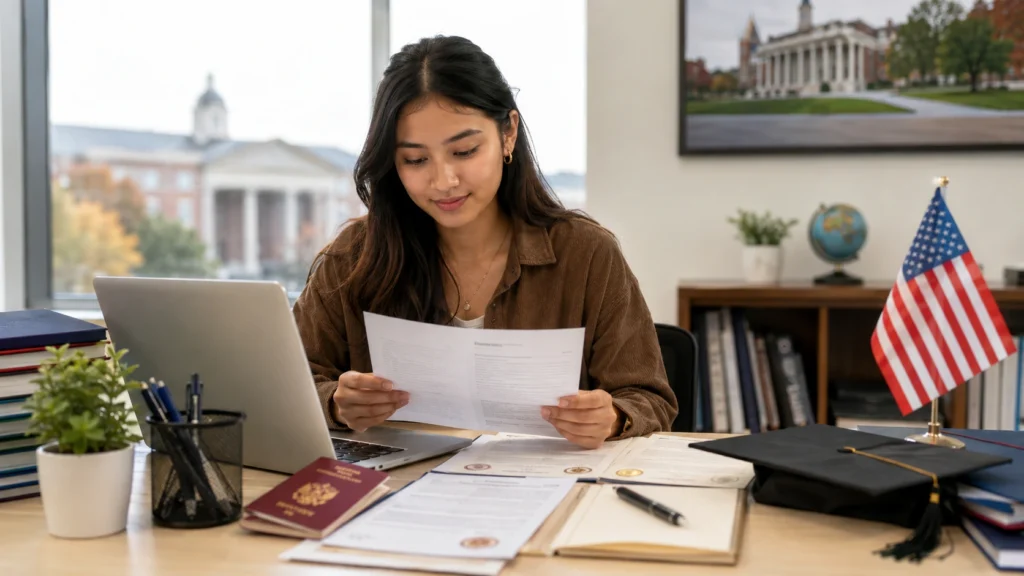
The main requirements for a PhD in USA include strong academics, research interest, English language ability, recommendation letters, a focused SOP, and sometimes GRE or GMAT scores. But the most important requirement is research fit.
Most universities expect a strong academic record. You may need a bachelor’s or master’s degree in a related field, depending on the program. A strong profile may include a good GPA, a relevant subject background, a thesis or research project, a publication if available, a research internship, or academic work experience.
For English, many international students need TOEFL or IELTS. Some universities may waive this based on previous education, but students should not assume it.
GRE rules are also different. Some PhD programs require the GRE, some make it optional, and some do not require it. Business-related doctoral programs may ask for GMAT or GRE.
Research fit is the heart of a PhD application. A university may reject even a strong student if no professor or lab matches the student’s research interest. Before applying, ask: Does this department offer my research area? Is there a professor working on my topic? Can I explain why I fit this program?
What Funding Options Are Available for a PhD in USA?
Funding options for a PhD in USA usually include Research Assistantships, Teaching Assistantships, fellowships, tuition waivers, and external scholarships. These can reduce tuition costs and may also provide a stipend, but they are competitive.
A Research Assistantship, or RA, usually means you work on a research project under a professor, lab, or department. In return, you may receive tuition support, a stipend, or both.
A Teaching Assistantship, or TA, usually involves helping with classes, labs, grading, tutorials, or student support. This can be a good option if you have strong communication skills.
A fellowship is often merit-based and may support students without requiring teaching or research duties in the same way as assistantships.
A tuition waiver means the university reduces or removes your tuition fee. But it may not cover living expenses, health insurance, books, or personal costs.
External scholarships can also help, but they are competitive. Students should use official university pages, EducationUSA resources, and trusted scholarship sources instead of depending only on random scholarship lists.
What Does a Fully Funded PhD in USA Actually Mean?
A fully funded PhD in USA usually means the university or department provides support that may cover tuition and offer a stipend, often through an assistantship or fellowship. However, “fully funded” does not always mean every cost in your life is covered.
A strong funding package may include a full tuition waiver, a monthly or annual stipend, a Research Assistantship, a Teaching Assistantship, a fellowship, health insurance support, and multi-year funding.
Before accepting an offer, check:
| Funding Item | What to Check |
| Tuition waiver | Full or partial? |
| Stipend | Monthly or yearly amount? |
| Health insurance | Included or separate? |
| Assistantship | RA, TA, or fellowship? |
| Duration | One year or multi-year? |
| Renewal | Automatic or performance-based? |
| Summer support | Included or not? |
Many students see the word “funded” and stop reading. Don’t do that. Funding details matter a lot.
How to Find Funded PhD Programs in USA
To find funded PhD programs in the USA, students should search university department pages, faculty profiles, graduate funding pages, assistantship listings, and official scholarship sources. The best funding information is often inside department websites, not only on general scholarship blogs.
Look for terms like graduate funding, PhD funding, assistantships, fellowships, tuition waiver, stipend, faculty research areas, and research labs.
Also, check the professor’s research interests. If your research interest matches a professor’s work, your application becomes stronger. You do not need to understand every technical detail, but you should understand enough to explain why their research connects with your goal.
Use reliable sources. EducationUSA is a U.S. Department of State network with more than 430 advising centers in over 175 countries and territories, giving students access to trusted U.S. higher education information.
Documents Required to Apply for a PhD in USA
The documents required for a PhD in USA usually include academic transcripts, degree certificates, CV, SOP, recommendation letters, English test scores, and sometimes GRE/GMAT scores, research statements, writing samples, or portfolios.
A PhD SOP should not sound like a general life story. It should explain your academic background, research interest, previous projects, why you chose that field, why that university fits, and what you want to research in the future.
Recommendation letters also matter. They should ideally come from professors, thesis supervisors, research mentors, or academic/professional supervisors who know your ability. A generic letter saying “he/she is a good student” is weak. A strong letter explains your research ability, discipline, writing skills, and academic potential.
PhD in USA Application Timeline from Nepal
The best time to prepare for a PhD in USA from Nepal is usually 12 to 18 months before your target intake. PhD applications need more time than regular study applications because you must prepare research-focused documents, shortlist professors, check funding, and meet early deadlines.
| Time Before Intake | What to Do |
| 12–18 months before | Choose a research area and build a profile |
| 10–12 months before | Prepare TOEFL/IELTS/GRE if required |
| 8–10 months before | Shortlist universities and professors |
| 6–8 months before | Prepare SOP, CV, LOR, and research statement |
| 5–7 months before | Submit applications |
| 3–5 months before | Attend interviews and review funding offers |
| After admission | Prepare I-20, SEVIS, DS-160, and F1 visa documents |
USEF Nepal notes that a doctoral program may take around five or six years for an international student, so early planning is important.
How Much Does a PhD in USA Cost Without Funding?
A PhD in USA without funding can be expensive because students may need to pay tuition, living expenses, health insurance, books, application fees, visa fees, and travel costs.
Costs can include tuition fees, living expenses, health insurance, books, application fees, test fees, transcript evaluation fees, SEVIS fee, visa fee, and airfare.
USEF Nepal gives a broad estimate that U.S. colleges and universities may cost around $15,000 to $65,000 per year, depending on the institution and level of study. That is why funding is not just a bonus. For many Nepali students, it is the main way to make a PhD study realistic.
Common Mistakes Nepali Students Make When Applying for a PhD in USA
Many Nepali students make mistakes because they treat PhD applications like normal admission applications. But a PhD application depends heavily on research fit, funding availability, strong documents, and early planning.
Common mistakes include applying only by university ranking, sending a generic SOP, ignoring funding details, applying too late, not checking professor fit, assuming the GRE is always required or always waived, and not preparing strong recommendation letters.
For PhD admission, a specific and well-prepared application is better than sending weak applications to many universities.
Profile Evaluation Checklist Before Applying
Before applying for a PhD in USA, students should check whether their academic profile, research interest, documents, and funding plan are ready.
Ask yourself:
- Do I have a clear research area?
- Do I meet the academic requirement?
- Do I have thesis, project, or research experience?
- Do I know which professors match my topic?
- Have I checked department funding pages?
- Is my SOP research-focused?
- Do I have strong recommenders?
- Do I need TOEFL, IELTS, GRE, or GMAT?
- Have I checked deadlines?
- Am I ready for the F1 visa stage?
If you cannot answer most of these clearly, don’t panic. It simply means you need more preparation before applying.
Is a PhD in USA Worth It for Nepali Students?
A PhD in USA can be worth it for Nepali students who are serious about research, academic growth, advanced professional work, or long-term specialization. It can open doors in universities, research institutions, industry labs, policy organizations, public health, technology, data, engineering, science, business, and many other fields.
But it is not for everyone. A PhD takes time, patience, and mental strength. Some days your ideas feel clear. Some days, your research makes you question your entire life. That is normal.
A PhD is worth it if you enjoy research, want deep expertise, are ready for long-term study, and understand that funding and admission are competitive.
How Crown Bridge International Can Guide You
Crown Bridge International can guide students who are planning to apply for a PhD in USA by helping them understand university requirements, application steps, documentation, funding options, and student visa preparation.
Crown Bridge can support students with profile discussion, guidance on university and program research, a document checklist, guidance on SOPs and CVs, funding information, application planning, guidance on student visa preparation, and personalised study abroad counselling.
However, students should understand that PhD admission and funding are not guaranteed. Funding depends on academic profile, research fit, department budget, professor availability, application quality, and university policy.
Need Help Planning Your PhD in USA Application?
Applying for a PhD in the USA can feel confusing, especially when funding, professor selection, documents, and visa steps are involved. Crown Bridge International can help you understand the process and prepare with better clarity.
Contact Crown Bridge International today for personalised study abroad counselling.
Call/WhatsApp: 9869855508